
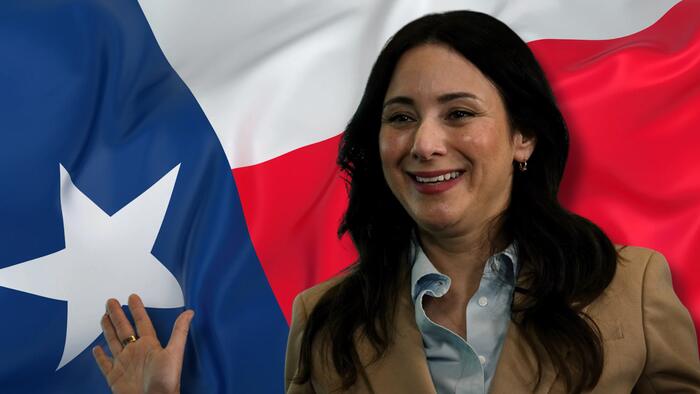
A year ago, plenty of Texans had never heard her name.
In January, Gina Hinojosa will be sworn in as governor.
The Austin Democrat defeated incumbent Gov. Greg Abbott on Nov. 3, ending the Republican’s bid for a record fourth term. She won 52.8% of the vote. She did it while being outspent on advertising by more than 4-to-1, about $118 million to $26 million.
“We did it,” Hinojosa told supporters on election night. “Everything is bigger, including the shock of this win.”
Weeks before, during early voting, Hinojosa sat down with KPRC 2’s ENOUGH team. She was asked what she would do as governor, where her record has shifted, and what she wants Texans to hold her accountable for.
For Texans or Americans who are just now getting to know her, here’s who she is, what she has promised, and what stands between those promises and your daily life.
Hinojosa, 52, will be the first Latina governor of Texas.
She is also the first Democrat to win the office since Ann Richards in 1990. Richards, who lost reelection to George W. Bush in 1994, was the last woman to hold the job.
Before Nov. 3, no Democrat had won a statewide race in Texas since 1994. Asked before the election why 2026 would be different, Hinojosa said voters were tired of both parties.
“People want change. People are so tired of politics as usual,” she told ENOUGH. “We have an opportunity that I think we’ve never had in my lifetime to forge a new way forward that is almost post-partisan.”
Hinojosa didn’t win alone. Democrats James Talarico and Vikki Goodwin won the races for U.S. Senate and lieutenant governor. Hinojosa also led in Collin and Denton counties, two suburban counties that backed Donald Trump in the last three presidential elections, according to the Associated Press.
Abbott first took office in 2015 after winning the November 2014 election. He called Hinojosa to concede, and she said he offered help with the transition.
Hinojosa was born and raised in the Rio Grande Valley. Hinojosa said she is a “proud product” of Brownsville public schools.
She graduated from the University of Texas at Austin and earned her law degree from George Washington University.
Her biography credits her grandmother with an early lesson that became a campaign theme: “No te dejes.” Her campaign translates it as “Fight back.”
She was a civil rights and labor lawyer.
Hinojosa represented union members and workers in disputes over wages, benefits, and fair treatment. In 2005, according to her campaign, she was part of the legal team that sued then-U.S. House Majority Leader Tom DeLay.
She says she never planned to run for anything.
That changed in 2012, when her son’s Austin elementary school was threatened with closure amid state budget cuts. She organized other parents, ran for the Austin Independent School District school board and won. The school stayed open until 2020.
Hinojosa was elected to the Austin ISD school board in 2012, where she served as president. She resigned in 2015 to run for the District 49 seat in the Texas House of Representatives.
10 years.
She ran for the Texas House in 2016 and won a seven-way Democratic primary without a runoff. She is now in her fifth term representing central Austin, including the University of Texas campus.
Her House biography lists these as her main work:
She sits on the House Public Education Committee.
Governor-elect said in her victory speech that she would work to “repair the damage of the Texas voucher scam.”
Hinojosa voted against voucher proposals in 2021 and 2023, and against the 2025 bill that created Texas Education Freedom Accounts (TEFA). The program is now funding more than 111,000 participants, according to the Texas Comptroller’s office.
Asked whether she would repeal it as governor, she pointed out that a governor can’t do that alone.
“I wouldn’t have the power to repeal that, but my record in the legislature, and my plan as governor, is to do everything in my power to make sure public money stays in our public schools,” she said.
Hinojosa promised to “repair” the program while working to “do no harm” to families already using it. She has also said she plans to fire Education Commissioner Mike Morath on her first day.
Asked whether she would sign a repeal if lawmakers passed one, she said yes, then added a caveat.
“I don’t see that as a reality, frankly, because it would have to make it through both the House and the Senate,” she said. “And unless everything flips in a big way, then I don’t see that happening. But yes, that is my priority.”
She also floated a different idea. Hinojosa said many TEFA applicants were seeking pre-K spots, which she said shows families are struggling to find affordable pre-K. She suggested letting public schools use the program’s roughly $10,000 per student to offer more pre-K seats.
She wants a moratorium on new data centers and an end to certain tax breaks.
ENOUGH asked about her own record. In 2023, she voted for House Bill 3104, which would have expanded tax exemptions for larger data center projects. The bill did not become law.
“What 2023 did was not to expand the tax breaks, but to say that union contractors could also get the benefit of them,” she said. “If anybody’s getting a tax break, it should go to subsidize Texas jobs.”
Asked what she would make data centers pay for, she pointed first to the sales tax exemption on the electricity they use. She said the exemption costs Texas more than $1 billion a year.
She also said Texans have no legal protection when data centers compete with them for water. She described meeting residents in Amarillo, where a massive data center project is planned. They told her the local water authority’s contract with the project has sparked concerns about water scarcity.
“These hyperscale data centers are having hyperscale impacts on our communities, and we’re just left unprotected,” Hinojosa said.
Yes, but expansion would require approval from the Legislature too.
About 16% of Texans have no health insurance, the highest rate in the country. Hinojosa said expanding Medicaid would allow the state cover more children.
Asked how Texas would pay for it, she said the federal government covers most of the cost. She argued Texans are already paying into that system.
“We should want the money we’ve put into the system to be benefiting Texans,” she said.
She says no to both.
Abbott’s campaign said Hinojosa voted 40 times to raise property taxes. ENOUGH looked into the claim and found she did not support 40 different bills to raise taxes. Hinojosa has said those votes were about local control.
“Local communities, they elect their local leaders to make those decisions with communities, and that’s my position, and that’s my record,” she said. She said she never voted to raise property taxes during her time on the Austin ISD board.
ENOUGH also asked about a 2016 comment in which she called a state income tax a missing part of Texas’ tax system. She now opposes one.
Hinojosa said the comment came before she was a lawmaker, when she was asked why Texans pay so much in property taxes.
“I said, I think it’s because we don’t have an income tax,” she said. After 10 years in the Legislature, she said, she now blames what she calls Abbott’s corruption, including state contracts that she says went to his donors.
She wants to send $1,500 to every Texas household from the state’s savings account, known as the Rainy Day Fund.
ENOUGH asked her to name one Republican priority she would support. She chose this plan.
“As since as long as I can remember, they want to shrink government,” she said. “That money doesn’t belong to the politicians, it belongs to people.”
She said the fund has historically held about $10 billion and now holds about $27 billion.
The rebate would need the Legislature’s approval.
She says she’ll fund it, but not the way Abbott did.
“Greg Abbott spent our taxpayer dollars, billions, like $20 billion, prosecuting immigrants for trespassing, and then also using that same taxpayer money to pay for their defense,” Hinojosa said. “It was political theater and nonsense.”
She pointed to her own record, saying she called the Biden administration when an international bridge was shut down and pushed for a deal with Mexico to enforce security on its side of the border.
We asked her whether that means Texas should spend less on border security.
“Public safety shouldn’t be a political stunt,” she said. “I will spend the money it takes to keep our community safe, not for political theater.”
She has not released a detailed border plan.
She voted against Senate Bill 14 in 2023. The law restricts certain gender-affirming medical treatments for minors, and she proposed letting it expire this year.
Asked whether she would keep, change or repeal it, Hinojosa said a governor couldn’t act on it alone. She said it isn’t what she hears about from voters.
“What I hear from Texans they care about is this high-cost economy,” she said. She called it one of the “culture war issues” that she said Abbott uses to distract voters.
ENOUGH told her that Republican voters say the issue matters to them, and that some are afraid for their children.
“I’ve never once heard from a family that they were afraid I was going to make their child transgender,” she said.
Abbott’s campaign cast Hinojosa as a high-tax liberal and framed the race as a choice between “common sense and crazy.”
Abbott ran on economic growth, property tax cuts and school choice. He proposed eliminating school district property taxes on homesteads.
Abbott did not debate Hinojosa. She told ENOUGH she believes candidates should be required to.
After the election, at least one Republican lawmaker, state Rep. Brian Harrison, called for a special session to limit the emergency powers Hinojosa will inherit. Abbott has not said whether he will call one.
Not by herself.
Repealing vouchers, expanding Medicaid, sending money to households and changing data center tax breaks all require the Legislature to pass bills. The governor can sign or veto them but can’t write them into law.
Hinojosa described it as a chess game. “We’ll make our move, they’ll make their move,” she said.
On election night, she signaled she’ll need more than her own party.
“We did not end one era of single-party rule to usher in another,” she said.
Hinojosa is scheduled to be sworn in Tuesday, Jan. 19, 2027.
Before the election, ENOUGH asked her what one thing Texans should hold her accountable for.
“For helping to make their lives better,” she said. “We pay for this government. It should be working for us. This should not be a novel concept.”
We’ll be tracking which promises move, which ones stall, and who has the power to make them happen.


